
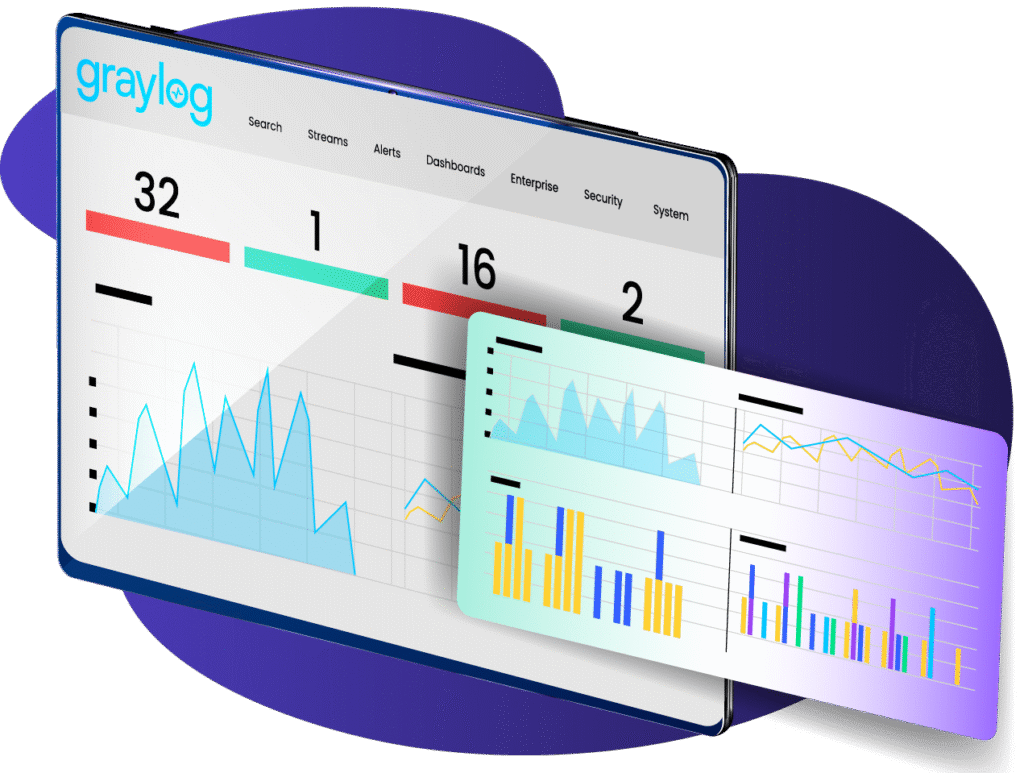
Why customers choose Graylog:
Created with direct input from security and IT professionals.
Fifteen years of community scrutiny shaping every release.
Transparent pricing across SaaS, hybrid, and on-premises deployments.
Adopted by more than 200,000 users in over 180 countries.
The people behind the platform
We measure everything we build against one question: can a lean team own this? Own it, tune it, and answer for it at audit time? That question decides not just what goes in the roadmap, but how those features are designed and built.
Our people have run systems like yours. Nearly every team at Graylog includes former practitioners and Open users, even Marketing! Our onboarding engineers have built these deployments many times over. Our support engineers and Technical Account Managers spend their days inside Graylog environments and know the product the way you know your own infrastructure. With Graylog, you get a team that stands by your side, solving the problems you bought a SIEM or CLM to solve, and treating you like the Lean Team Hero you are.
You have plenty of platforms to choose from. Capabilities can be matched. It’s the people behind the platform who make it work for you and your environment that make the difference.
On-demand and live training options tailored to your pace.
Fast and accurate deployment guidance.
Global experts, on call when something isn't working right.
In your instance, building what you need.
Your contact for reviews, renewals, and planning.
Four things you won't find together anywhere else
AI that shows the work.
AI in security tooling usually hands you a conclusion without showing how it got there. That’s fine until an auditor, a manager, or your own instinct asks why.
Graylog works the other way around. It explains what it found and shows you the evidence behind it. Then you decide.
It reads what’s in front of you and tells you what changed. You get the related context before you think to ask. And it writes up what it found in language you can hand to someone else.
It works with the AI tooling you use today, under your existing access controls. Your model, your rules.
Data pipeline management, included.
Most teams control cost by collecting less. That works right up until the log they dropped turns out to be the one they needed.
Graylog decides where data goes the moment it arrives. High-value data into active analytics. Everything else into a data lake that’s part of the platform, not a separate product with its own contract. When an investigation or an audit needs something from the lake, you bring it forward.
Volume is a platform question, not a product question. Security logs, application logs, infrastructure noise — it all arrives in the same pipeline, sorted on the way in.
Keep everything. Spend attention on what matters. That’s intelligent data control.
Coverage grows with your environment instead of your invoice.
Run anywhere your data lives.
Our cloud, your cloud, or your own data center, including air-gapped. Same platform, with feature parity across deployments.
Deployment isn’t a permanent decision. Regulations change, regions change, companies get acquired, and residency requirements arrive with little notice. Graylog moves with you, and your data and configuration come along.
Open formats and open APIs, so Graylog fits what you already have.
Where your data lives stays your decision.
Threat prioritization that creates a case.
A thousand alerts rarely means a thousand problems. Most of them are a handful of real incidents seen from a dozen angles, and sorting that out is where the day goes.
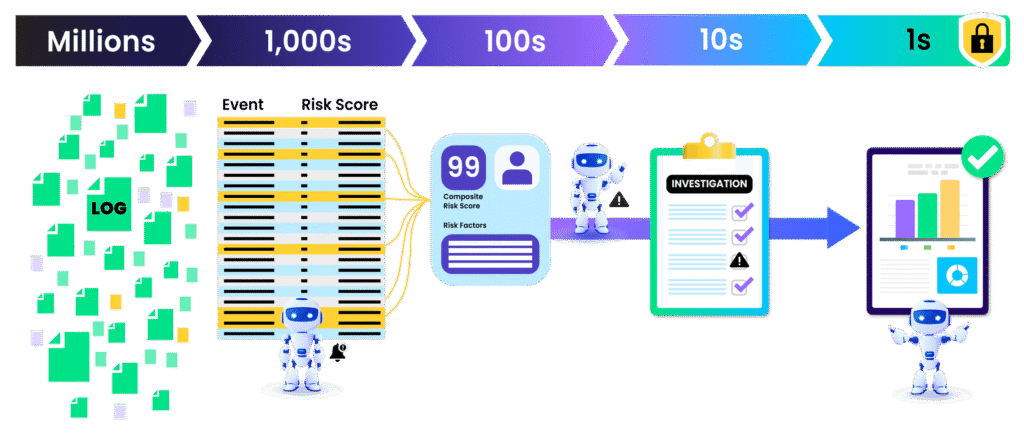
Graylog scores each alert as it arrives, then correlates them by what they share — an address, an asset tag, an identity — into one score for the entity behind them. Asset criticality, vulnerability findings, and live attack campaign patterns raise or lower it.
Thousands of alerts resolve to a few hundred scored entities, then to just a few real incidents.
Context-aware incident response picks it up from there. A score crosses your threshold and the case opens already assembled: related events, timeline, response steps. That comes with the platform, and it passes cleanly to the tools you run downstream.
The compromises you no longer have to make
Dropped packets, blocked connections, Sysmon on workstations. These are some of the noisiest sources you have, and often the first ones filtered when nobody could justify them at renewal. It made sense at the time, but it never got written down as a coverage decision. Instead it became the baseline, and the next year's cut started from there.
Send the noisy sources to the built-in data lake, where that data doesn't count against your license. When an investigation needs day forty, it's easily retrieved from Archive. Decide collection and retention on need and risk, not budget.
A hundred alerts a day. Forty get worked properly. The other sixty get a look and a close, and you know something real is in there. Meanwhile your senior analyst spends half her shift walking two juniors through the same triage steps.
A ranked queue means the day starts at the top of it, and any analyst on shift can work down. Cases open assembled, so the first thing anyone does is decide.
Detections do get written down. Two years on, some are disabled and nobody remembers who turned them off or why, a few overlap, and it's hard to say what any single one actually catches — or which sources aren't covered at all.
You can tell what each detection fires on and which of your sources are going unwatched. A new analyst can read the state of the set for themselves.
IT Ops needs log data. So does the application team, and finance during a review. Every request is a ticket, then a wait, then someone on your team pulling the export by hand.
Give the teams that need log data their own access, under permissions you set. They see what your analysts see, scoped to their role.
The audit request lands and the week goes to assembling the response. Screenshots and exports and spreadsheets sent over by email.
Evidence accumulates while the work happens, so producing it is a quick report you access or an easy query you run. Security and IT pull from the same record.
How a lean team gets it done
Click through what the Graylog platform delivers. →


Before Graylog, security operations at Circles were almost non-existent. Today, Graylog is the centerpiece of our SOC maturity.
Graylog helps teams reduce alert fatigue, improve detection speed, and make better use of their time.